
Ghost Controls Gate Repair in Santa Rosa: A Homeowner’s Guide
Ghost Controls gates fail quietly. No error code, no blinking fault light, just a gate that stops responding – and a solar indicator still showing green while the system is starved for power. That single quirk trips up more Santa Rosa homeowners than any mechanical problem, because it makes a dead battery look like a healthy one. This guide walks through how a Ghost Controls system actually works, the parts worth testing separately, and when a repair stops making sense.
If you’d rather not climb this diagnostic ladder yourself, call (888) 298-3409. The estimate is free, and the price is set by the written estimate before we touch a thing.
Key Takeaways
- A green solar indicator does not mean the battery or controller is healthy.
- Treat the actuator, control box and remote receiver as three separate components when you test.
- Ghost Controls actuators are unusually sensitive to gate sag and weight imbalance on wooden farm gates.
- Opening the sealed control box is the fastest way to void a warranty.
Why does a Ghost Controls gate stop responding with no error code?
A Ghost Controls gate usually goes silent because the system is designed for rural simplicity, not for reporting faults. There’s no diagnostic screen and no trouble code habit like you’d find on a FAAC or BFT commercial operator. When power falls below what the actuator needs, the gate simply stops mid-travel or refuses to start, and nothing on the control box announces why. In our experience around Santa Rosa, that low-voltage stall is the number one call we get on these units.
The green solar indicator is the culprit in most of those cases. On a solar-charged system, the indicator reflects whether the panel is producing charge, not whether the battery is holding it or whether the controller is delivering it where it’s needed. A panel in shade for part of the day, or one that’s drifted out of angle, can still read green while the battery sits far below the voltage the actuator requires. Meanwhile the controller may be fine, the actuator may be fine, and the whole gate is dead anyway.
Santa Rosa’s mild winters help here – no deep cold to flatten a battery overnight – but the long dry season is its own problem. Dust and leaf debris collect on panel glass and cut output over weeks. If you’ve cleaned the panel, checked every connection in the run, and the gate still won’t move, that’s the point where a voltage test on the battery under load tells you more than another visual inspection.
How do you test a Ghost Controls GC1 or GC2 single-gate kit?
You test a Ghost Controls GC1 or GC2 by splitting it into three components – actuator, control box and remote receiver – and checking each on its own. Most people treat the unit as one black box, replace the whole thing out of frustration, and never learn which part actually failed. The kits are simple enough that a methodical test usually finds the fault in one of the three.
- Power first. Confirm the battery reads a healthy voltage under load, not just at rest. A resting reading can look fine on a battery that sags the moment the actuator draws current.
- Actuator rod. Disconnect the arm from the gate, then run the operator. If the rod extends and retracts cleanly with no load, the actuator is likely sound and the problem is load or binding.
- Control box. With the actuator still disconnected, check that the board responds to the manual input. No movement here points to the controller or its power feed, not the arm.
- Remote receiver. Test the gate with a wired input or the manual release. If it runs from a wired command but not the remote, the receiver or its pairing is the issue, and the rest of the system is healthy.
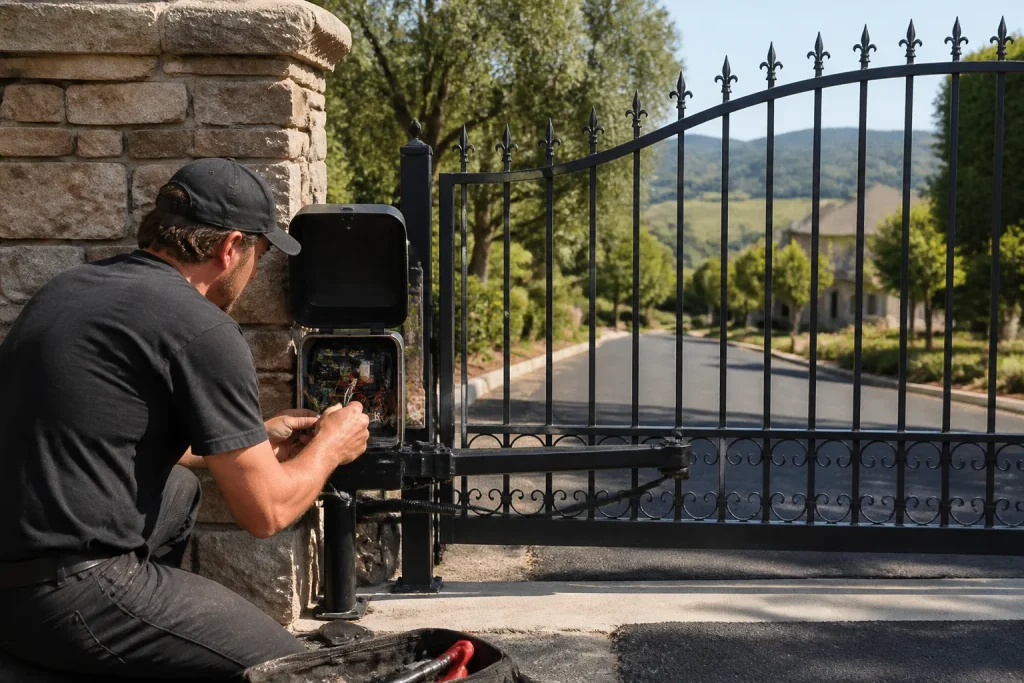
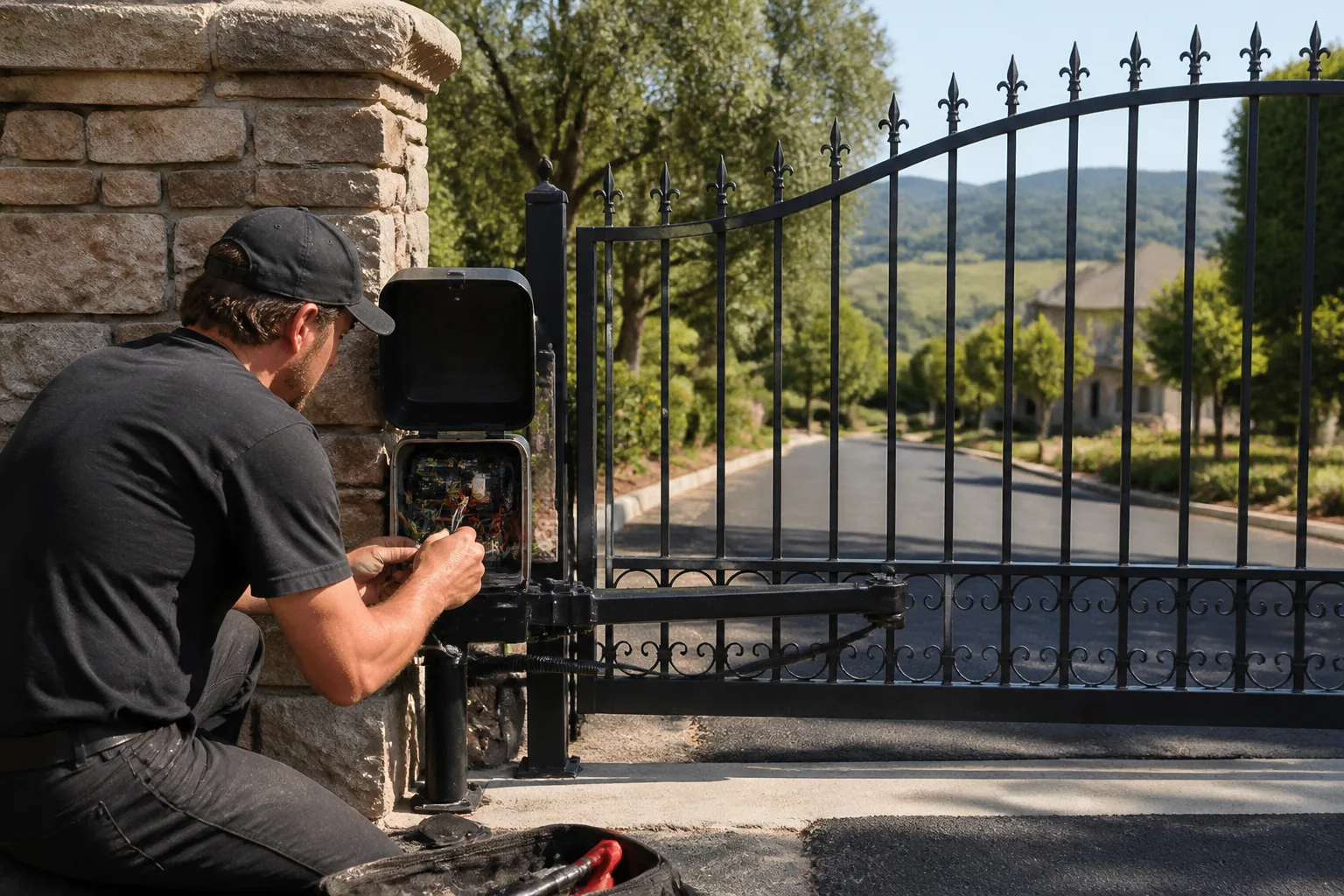
That split-test approach is how we diagnose at the operator board level rather than swapping parts and hoping. It’s also the reason we can tell you honestly whether your Ghost Controls unit needs a component or a full replacement. If you’re not comfortable inside the control enclosure, our electric gate repair service covers the full electrical and control side.
Why are Ghost Controls actuators so sensitive to gate weight and sag?
Ghost Controls actuators are light-duty by design, built for single residential gates on modest runs, and that makes them sensitive to a gate that no longer swings true. The actuator doesn’t know your gate has sagged. It only knows the load has gone up, so it works harder, draws more current, and eventually stalls or trips out – often intermittently, which is the most frustrating kind of failure to chase.
Wooden farm and ranch gates are the usual suspects in Santa Rosa, and for good reason. Wood absorbs and releases moisture, and a gate that hung clean in spring can sag by late summer as the frame and hinge side shift. The gate still looks fine from the driveway. It isn’t fine from the actuator’s point of view.
Here’s how to check for sag before blaming the operator:
- Release the actuator arm and swing the gate by hand. If it binds, drags, or needs a push to close, the problem is the gate, not the opener.
- Look at the gap at the latch post. A changing gap over the seasons is a sign the gate is moving.
- Check the hinges for play and the posts for lean. A leaning post loads the actuator on every single cycle.
- Watch for the gate dipping at the far end. A small dip can mean a large increase in the force the actuator has to overcome.
Fixing the gate’s swing often resolves a Ghost Controls stalling problem entirely, with no new parts at all. That’s the diagnose-first approach we take on every job, and it’s cheaper for you than replacing an actuator that was working against a bad gate the whole time.
Which Ghost Controls repairs void the warranty?
The most common warranty-voiding mistake Santa Rosa homeowners make on Ghost Controls units is opening the sealed control box. Once that enclosure is opened, most manufacturers consider the warranty terms affected, and any fault you were hoping to claim becomes a repair you pay for. Ghost Controls isn’t unusual there – FAAC and Viking take a similar line on sealed enclosures – so it’s worth understanding before you reach for a screwdriver.
Other repairs that tend to void coverage or cost you a claim:
- Cutting or splicing the actuator cable to shorten the run, instead of routing it properly.
- Swapping in a battery or panel that doesn’t match the system’s specification, which can also stress the controller.
- Sealing the control box against moisture with caulk or foam that traps heat and condensation inside.
- Changing the actuator mounting position or drilling new holes in the housing.
None of this means you can’t check the obvious things – panel cleanliness, a healthy battery reading under load, a gate that swings freely. It does mean the moment you’re into the sealed electronics, the smart move is to stop and let a technician who works on these systems daily take it from there. We keep the warranty intact and get to the real fault instead of guessing at it.
When is a Ghost Controls system worth repairing versus replacing?
A Ghost Controls system is worth repairing when the fault is a single component – a tired battery, a failed receiver, a binding gate – and the operator itself is still healthy. It’s worth thinking about replacement when the gate’s use has climbed well past what the unit was built for. Ghost Controls is designed for light-duty residential duty. If your gate now runs dozens of cycles a day because the household, the deliveries and the comings and goings have all increased, the operator is doing more work than it was meant to do.
That’s when a higher-duty operator starts to make sense. On a heavier, busier gate, a Linear or BFT unit built for continuous cycling will outlast a light-duty opener that’s being asked to work like a commercial system. There’s no rule of thumb that fits every gate, but a rising cycle count plus repeat stalls on the same unit is the pattern that points toward upgrading rather than repairing a fourth time.
The right call depends on the gate, the cycle count and what’s actually failing. We work on the brand you already own, and we recommend replacement only when repair genuinely isn’t cost-effective. That honest read is the whole point of a dedicated gate specialist rather than a general repair tech who guesses.
When to call a pro
Call a professional when the fault sits inside the sealed controls, when you’ve cleaned the panel and checked the battery and the gate still won’t move, or when a binding gate needs its hang and hardware corrected, not just its operator reset. Our team handles the whole gate, from the operator board to the hinge pin, so one call covers the whole gate. If you’re in Santa Rosa and your Ghost Controls gate has gone quiet, that’s exactly the kind of call we take.
The Bottom Line
Ghost Controls gates go silent for a handful of predictable reasons, and the green solar light rarely tells you which one. Test the actuator, control box and receiver as three separate parts. Check the gate’s swing and sag before you blame the operator. And leave the sealed electronics to a technician so you don’t void the warranty while chasing the wrong fault. Our technicians have up to 14 years of experience across the major gate and operator brands, from Ghost Controls and Mighty Mule up through LiftMaster and DoorKing, and electric gate repair is a named specialty here. Diagnose first, replace only when necessary – that’s the rule we work by.
Related services in Santa Rosa
For automated systems, control boards and safety sensor work, see our gate repair page. You can also start from the main Gate Repair Santa Rosa page to see the full scope of what we cover.
If you’re in Santa Rosa and need help, Gate Repair Santa Rosa offers free estimates – call (888) 298-3409. We answer 24/7. Fast dispatch from 7am to 7pm, Sunday through Friday.
Frequently Asked Questions
Often, yes. Most Ghost Controls faults – a dead battery, a binding gate, a failed receiver – can be diagnosed and sorted on a same-day visit when the right parts are available. Call (888) 298-3409. We answer 24/7. Fast dispatch from 7am to 7pm, Sunday through Friday – and a call outside dispatch hours is booked into the next opening.
Because the green indicator tracks solar charge, not battery health or controller output. The panel can be producing voltage while the battery fails to hold it or the controller stops delivering it to the actuator. A load test on the battery is the way to know. Call us for an exact quote – estimates are free.
Repair it if the fault is a single component and the gate’s cycle count is modest. Upgrade if the gate now runs far more cycles a day than a light-duty opener was built for, or if the same unit keeps failing. Call (888) 298-3409 for an exact quote – estimates are free.
Very likely, yes. Most manufacturers, Ghost Controls included, treat a sealed control enclosure as warranty-sensitive once it’s opened. Check the free-looking things first – panel, battery, gate swing – then call us before you open the box. Call (888) 298-3409 – estimates are free.
Written by the team at Gate Repair Santa Rosa.
Need Gate Repair Help?
Call Gate Repair Santa Rosa - licensed & insured, here with fast help in Santa Rosa.
(888) 298-3409